

Trawling is one of the most widely used techniques in industrial fishing due to its high catch capacity and adaptability to different species and fishing grounds. However, it is also one of the methods that generates the most debate because of its effects on marine ecosystems. For this reason, the sector is moving toward the progressive improvement of trawl fishing gear, incorporating technical solutions that help reduce certain environmental impacts without compromising onboard operations—such as the use of eco-friendly fishing weights.
What Does Trawling Involve?
Trawling is based on towing a large net from a fishing vessel. In the case of bottom trawling, the net operates in direct contact with the seabed to catch demersal species. The proper functioning of the system depends on the balance between buoyancy, net opening, and weight, making ballast components an essential element of trawl fishing gear.
Trawling: Consequences and Technical Limits
The consequences of trawling are well documented, among which seabed disturbance stands out as a direct result of the physical contact between the net and its components and the ocean floor. This impact cannot be eliminated by a single technical element, as it is inherent to the functioning of this type of gear.
However, alongside this primary impact, there are other associated effects, such as pollution resulting from lost materials, the accumulation of waste on the seabed, and the use of components made from highly polluting materials. It is in this area that the industry can act directly by improving the materials used.
The Role of Eco-Friendly Fishing Weights in Trawl Gear
In trawl fishing gear, weights play a critical role in ensuring the stability and working depth of the net. Traditionally, these ballasts have been made from materials such as lead, which, in the event of loss, can remain in the marine ecosystem for long periods and pose a pollution risk.
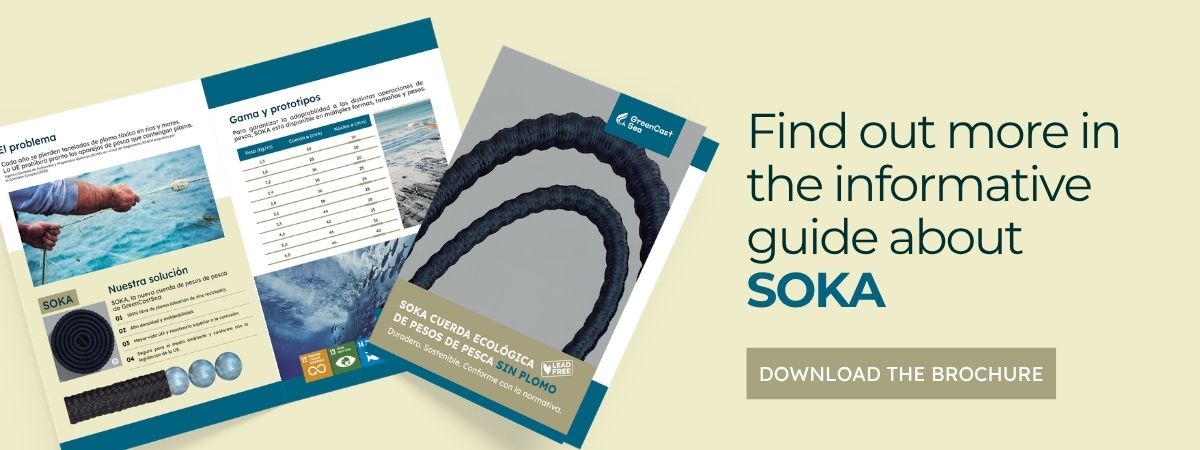
To address this issue, GreenCastSea has developed SOKA, a rope of eco-friendly fishing weights made from recycled zinc alloy and 100% lead-free, designed as a sustainable alternative for industrial fishing.
SOKA: Reducing Impacts Without Altering Operations
It is important to note that the use of SOKA does not eliminate seabed disturbance, as this effect is linked to the trawling process itself. However, it significantly contributes to reducing secondary environmental impacts, especially in cases where material is lost during fishing operations.
Thanks to its lead-free composition and high corrosion resistance, SOKA reduces the pollution associated with traditional ballasts and minimizes long-term waste generation. Its high density ensures proper technical performance in bottom trawl nets, maintaining the efficiency and effectiveness required in industrial fishing.
In addition, its durability reduces the frequency of weight replacement, optimizing resources and lowering the material footprint of operations.
Toward More Responsible Trawling
The evolution of industrial fishing requires acknowledging the consequences of trawling and taking action on those elements that can be realistically and effectively improved. Although seabed disturbance is an inherent impact of this technique, adopting more responsible materials in trawl fishing gear represents a concrete step toward greater sustainability.
Incorporating solutions such as SOKA, based on eco-friendly fishing weights, enables fleets to advance regulatory compliance, reduce marine pollution, and strengthen their commitment to more responsible professional fishing—without compromising operational efficiency.